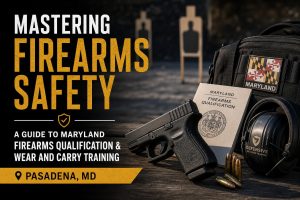
In Maryland, training versus approval is the key distinction: completing security-guard or firearms training may satisfy a training requirement, but it does not by itself authorize you to work as a security guard, carry a handgun, receive a state certification, or get hired. You still must follow the Maryland State Police application process, submit required documents, and receive the proper approval before acting under that credential or permit.
That point can feel frustrating if you’ve already spent time in class. But it protects you from a costly mistake. A course certificate, an application receipt, or a pending application is not the same as government approval.
STA Security Training Academy provides security and firearms training for aspiring security professionals and responsible adults in Maryland. STA is not the licensing authority. Training through STA does not guarantee a license, permit, employment, certification, or state approval.
On this page
The central distinction: training versus approval
The most important issue is training versus approval. Training shows that you completed instruction. Approval means the proper authority reviewed your application and granted the credential or permit.
Those are not the same thing. A training provider can teach a course and provide documentation of completion. The State of Maryland decides whether you qualify for a state-issued certification or permit.
For security guard work, that generally means Maryland Security Guard Certification through the Maryland State Police process. For handgun carry, that generally means a Maryland Wear and Carry Permit. Each process has its own application steps.
Think of training as one required document in a larger file. It may be necessary. It may be very important. But it is not the whole decision.
Here is an illustrative example. If a student completes an approved initial security training course, the student may have met the training portion of the process. The student still must complete the state application steps, provide required documents, and wait for state review. The same logic applies to permit-related firearms training.
This article gives general educational information for Maryland readers. It is not legal advice for your personal situation. If your background, job role, or permit status is complicated, speak with the appropriate agency, employer, or qualified legal professional.
Maryland security guard certification prerequisites
Maryland’s security guard process starts with eligibility and documentation. The official Maryland State Police Security Guard Certification page says an applicant generally must be at least 18, meet applicable standards, and be employed or seeking employment with a licensed security guard agency or security guard employer.
The same Maryland State Police page also describes character and criminal-history requirements. It lists 12 hours of initial security training approved by the Maryland Police Training and Standards Commission as part of the process.
This is where training versus approval often gets confusing. Completing 12 hours of approved initial training may satisfy a training requirement. It does not automatically create a Maryland certification.
Before you rely on any course for a state requirement, confirm the exact course name, approval status, and current instructions. Course availability, prerequisites, and agency requirements can change.
STA Security Training Academy serves Maryland students who are preparing for security and firearms-related responsibilities. To review current training information, start with the official STA website at https://www.securitytrainingclasses.com/. A human reviewer should confirm the exact course page and wording before publication.
What happens after security guard training
After training, the process turns administrative. Maryland State Police says the applicant must submit Livescan fingerprints, a recent color passport-style photograph, training documentation, and the certification application through the Maryland Licensing Portal.
The agency or employer has a role too. The official security guard certification page states that the agency or employer must review and submit the application. Then the Licensing Division reviews completeness and conducts a background investigation.
This step matters because training versus approval is not just a classroom issue. The application must move through the state’s system. Missing documents, employer review, or background issues can affect the result.
Maryland State Police says applicants receive an approval or disapproval email within 90 days. It also states that an approved certification is valid for three years from its year of issuance. Always check the current state page before applying, because procedures may change.
Until the state approves the certification, do not assume you may work in a role that requires it. Your employer may also have separate hiring, onboarding, and assignment rules. Training completion does not force an employer to hire or schedule you.
Training provider versus government authority
A training provider and a licensing authority do different jobs. Understanding this helps you avoid mixing up training versus approval.
STA can provide training within its current course offerings. STA may provide documentation when a student completes a course. But STA does not issue Maryland Security Guard Certification or a Maryland Wear and Carry Permit.
The Maryland State Police Licensing Division regulates security guards and security agencies. The Licensing Division also identifies the online systems used for professional licenses and handgun permits.
That means the final decision belongs to the state, not the classroom. The state may review identity, fingerprints, training documents, employment information, background information, and any other required application material.
For students, this creates a simple rule: keep your training documents, but do not treat them as permission. Use them as part of your application package.
Wear and Carry Permit administrative steps
Maryland’s Wear and Carry Permit process has its own requirements. The official Maryland State Police Wear & Carry Permit page says a new applicant generally needs a 16-hour MSP-approved firearms-safety course from a Qualified Handgun Instructor, unless an exemption applies.
The application also involves fingerprints, a photograph, required training documentation, and submission through the Licensing Portal. These are administrative requirements. This article does not provide firearms handling, shooting, tactical, or operational instructions.
Again, the issue is training versus approval. A firearms-safety course may be required for a new application. But the course certificate is not the permit.
If you are taking training for a permit-related purpose, confirm that the course fits the current Maryland requirement before you enroll. Also confirm whether any exemption applies to you through official sources. Do not rely on assumptions from a friend, old web page, or social media post.
For current STA firearms and safety training information, visit STA Security Training Academy online or call (443) 702-7891. Before publication, the exact course name and approval language should be verified on STA’s official site.
A pending permit application is not permission to carry
This is the clearest practical warning in the permit process. Maryland State Police expressly states that submitting a Wear and Carry Permit application does not authorize a person to carry a handgun.
The state says an applicant must receive approval and the permit card before legally wearing, carrying, or transporting a handgun. That statement appears on the official Wear & Carry Permit page.
So, in plain language: a completed course is not enough. A submitted application is not enough. A pending review is not enough. The required approval and permit card must come first.
This is another example of training versus approval. Training may prepare your application. Approval is what changes your legal status under the permit process.
If you are unsure whether you may carry in a specific situation, get guidance from the Maryland State Police or a qualified attorney. Laws and personal facts both matter.
Special note for designated security personnel
Some security-related roles have additional firearm qualification details. The Maryland State Police Firearms Safety Training page states that designated security personnel include security guards, private detectives, special police, and armored-car drivers or guards.
The same state page refers to the Practical Police Course qualification requirement for those designated security personnel. Because these requirements can be role-specific, check the official state page for the current wording and required documentation.
This section is administrative only. It does not explain how to fire, handle, qualify with, store, transport, or use a firearm. Those subjects require proper in-person instruction and must follow current law and safety standards.
For a student, the useful takeaway is simple. If your job role involves security work and a firearm, do not assume one class covers every state, employer, and role requirement. Confirm each requirement in writing before you act.
Which Maryland system handles which application
Maryland State Police distinguishes between its Licensing Portal and eMDSP Online Services. The Licensing Division page identifies the Licensing Portal for professional licenses such as Security Guard Certification and Wear and Carry permits.
The same page identifies eMDSP Online Services for items including the Handgun Qualification License and Qualified Handgun Instructor services. This system detail matters because using the wrong portal can delay your next step.
Before you apply, check the official page for the credential you need. Follow the current portal instructions from Maryland State Police. Do not rely only on saved bookmarks, screenshots, or older instructions.
This is also part of training versus approval. A training provider can help you understand course completion. The government portal is where the state application process moves forward.
4 planning steps before you rely on training
Use these four planning steps before you treat a course certificate as part of a Maryland security or permit process.
- Identify the credential you need. Security Guard Certification, a Wear and Carry Permit, a Handgun Qualification License, and employer onboarding are not the same thing.
- Match the course to the requirement. Confirm the exact course name, approval status, instructor requirement, hours, and documentation before enrolling.
- Prepare the application documents. The state process may require fingerprints, a photograph, training documents, employer or agency review, and portal submission.
- Wait for the actual approval. Do not work in a role or carry a handgun based only on course completion, an application receipt, or a pending review.
These steps help keep training versus approval clear. They also make your conversation with a training school, employer, or state agency more productive.
If you are comparing next steps, write down the credential name first. Then list the training requirement, documents, portal, employer role, and approval you still need. This small checklist can prevent a major misunderstanding.
FAQs
Does completing security guard training let me start work right away?
Not by itself. Training may satisfy one requirement, but Maryland Security Guard Certification involves a state application process, employer or agency review, required documents, and state approval. Your employer may also have separate hiring steps.
Is a firearms course certificate the same as a Wear and Carry Permit?
No. This is a common training versus approval mistake. A course certificate may support your application, but the Maryland State Police must approve the permit and issue the permit card before you may rely on it.
Who decides whether I am approved?
The State of Maryland makes the approval or disapproval decision for Maryland credentials and permits. A training provider does not make that final decision and cannot guarantee the result.
What should I check before I enroll in a class?
Confirm the exact course name, whether it fits the current Maryland requirement, the documents you receive after completion, and any prerequisites. Also check the official Maryland State Police page for the credential you plan to seek.
Can STA answer questions about current training options?
Yes. STA can discuss current training options shown on its official website. For course questions in Maryland, visit https://www.securitytrainingclasses.com/ or call (443) 702-7891. For state approval questions, check Maryland State Police guidance.
If you are planning your next step in Maryland, STA Security Training Academy can help you understand available training options. Just keep the main rule in mind: training supports the process, but Maryland approval comes separately.